
Report #15 Protect The Commons
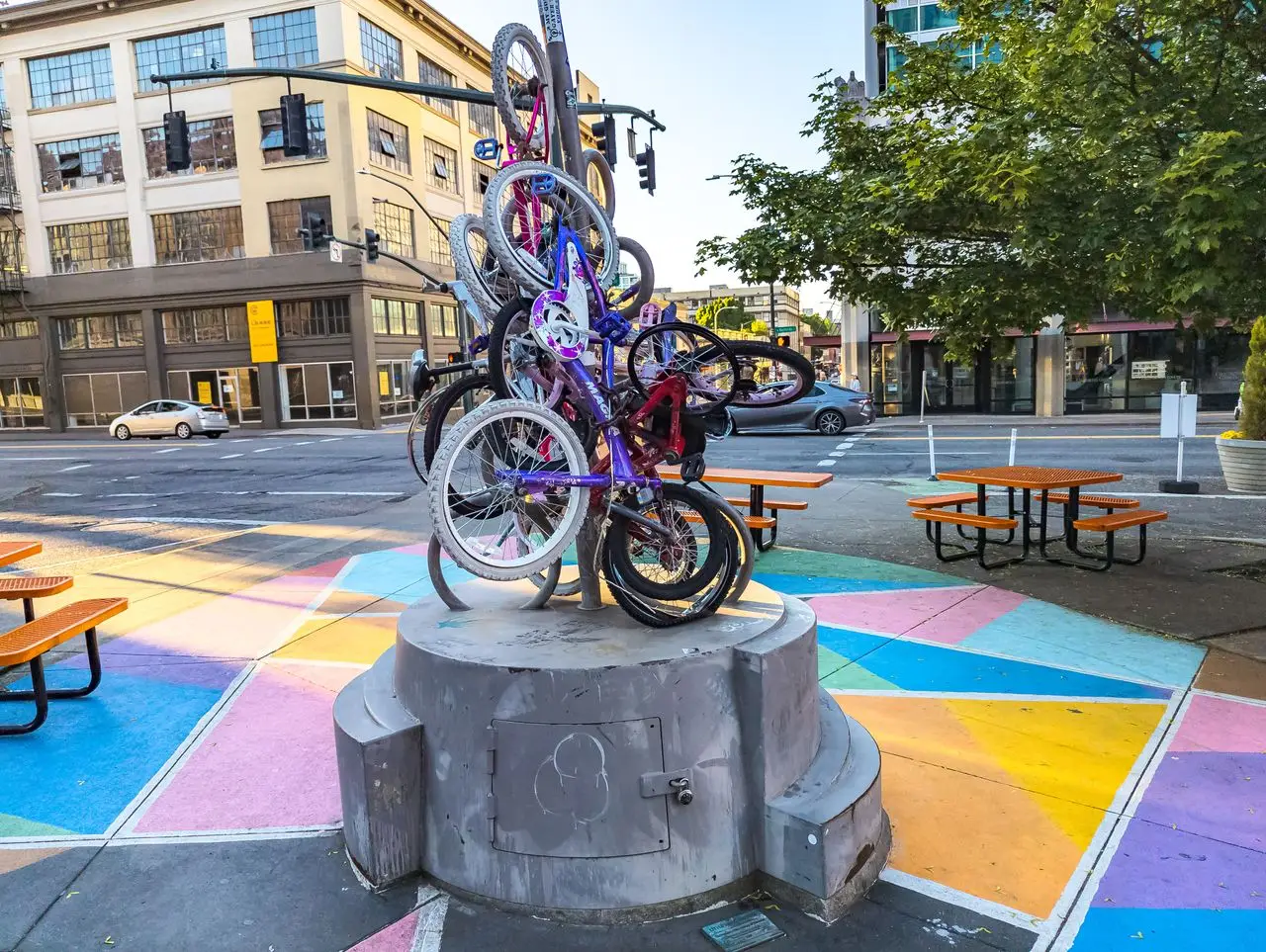
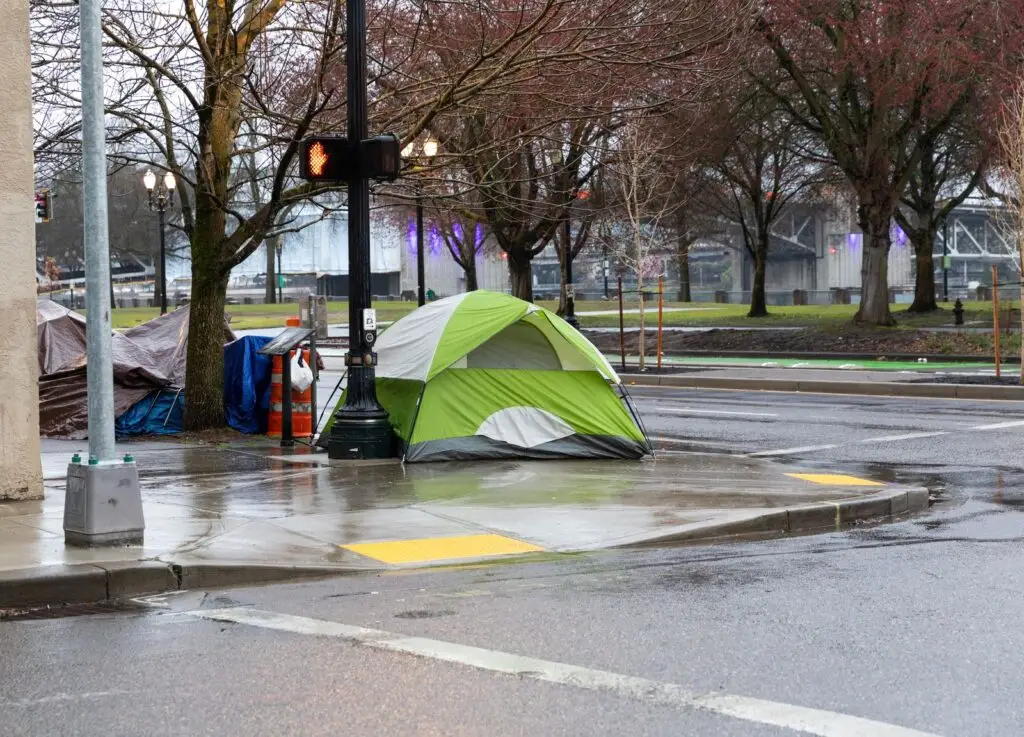
In Portland, the commons include streets and sidewalks, parks, libraries, transit vehicles, shelters, public restrooms, community gardens, tool libraries and shared neighborhood spaces. Public space is where an unhoused Portlander sleeps, washes, keeps warm and dry, stores what he owns and is found by an outreach worker if he is found at all. It is also where the rest of us walk to work, take our children to a park, library or school, wait for a bus and is critical to the success of businesses.
The financial cost to taxpayers of a deteriorated commons is significant. Portland Voice conservatively estimates the annual public cost of homelessness in Multnomah County at $838 million. Other researchers, such as ECOnorthwest, have come up with lower figures in the range of $500 million but only measure direct services to the homeless rather than the full public cost. An accurate accounting should include excess costs attributable to homelessness for behavioral health, emergency room visits and hospitalization, police and fire department services, and private sector costs such as increased need for security guards, replacing broken windows, car break-ins, empty office buildings, and the negative impact on business.
One can argue about different methodologies measuring the impact on Multnomah County residents of homelessness, but under any analysis, it is huge amount of money that instead could be directed toward education, mental health and medical care, for all residents of the County. This is at a time when the number of people experiencing homelessness increased 29% in fifteen months between January 2025 and March 2026.
This all makes the fifth of our Five Principles the hardest to define. Protecting the commons gets framed as a contest between compassion for homeless people and order for everyone else. It is not a contest, and the people who suffer most from a degraded commons are the people who live in it.
How We Got Here
The punitive instinct is old and has been tried. Through the nineteenth and parts of the twentieth centuries, American towns and states used Poor Laws and Vagrancy Laws to arrest, punish or banish the destitute, and what safety net existed was private charity almshouses and cheap single room occupancy hotels in the skid rows of major cities.
Three decisions since 1980, however, produced the streets we have now. State mental hospitals closed without the community care that was promised. Urban renewal and zoning eliminated a million single room occupancy units, the housing of last resort for poor single adults. And federal housing expenditure was cut. From the 1990s onward the old charity model to address homelessness gave way to Housing First, which in its original conception included robust treatment for addiction and mental illness. As with deinstitutionalization, the treatment component was ignored or underfunded, and Housing First became, in practice, Housing Only.
Combined with the shift from opioids and cocaine to methamphetamine and fentanyl, the result has been failure. Housing without wrap-around services for someone suffering severe addiction or psychosis produces crime, fires and property destruction in the buildings where they are housed, which drives out other tenants and bankrupts providers through insurance costs.
The Law of the Commons
In Martin v. City of Boise, the Ninth Circuit held in 2018 that the Eighth Amendment barred cities from criminally punishing homeless people for sleeping outdoors where the number of people exceeded practically available shelter beds. In City of Grants Pass v. Johnson, decided June 28, 2024, the Supreme Court held that enforcing generally applicable public camping laws is not cruel and unusual punishment, effectively overruling Martin.
Oregon House Bill 3115 (2021) requiring any Oregon city or county law that regulates sitting, lying, sleeping or keeping warm and dry on public property be objectively reasonable as to time, place and manner, judged on the totality of the circumstances as applied to all stakeholders, including unhoused people, and is not impacted by City of Grants Pass.
Portland’s ban prohibiting camping on public property when reasonable shelter is available began November 1, 2025, with penalties of up to $100 or a week in jail. There are also specific restrictions, regardless of shelter availability, in public spaces prohibiting obstruction of pedestrian use of the sidewalk and interference with adjacent businesses. Deflection into treatment as an alternative to fines and jail is prioritized. To date, there have been no convictions, no one was jailed, and no successes, if defined as helping the individual achieve stability and housing. Enforcement is functioning almost entirely as a shelter referral system because the deflection pathway is not effectively implemented.
In 2025, combined closures by city and county resulted in 1,566 fewer shelter units. Thus, we are trying to enforce an ordinance which under state law turns on reasonable shelter being available, while removing 1,566 shelter units.
Federal Policy
Executive Order 14321, “Ending Crime and Disorder on America’s Street” (July 24, 2025) redirects federal homelessness policy from housing toward treatment and enforcement. In its emphasis on treatment, the order names a real failure, but it reverses Housing First policies in favor of treatment programs. As the housing provisions of this Order have lost three times in federal court, the federal policy seems now to be “Treatment Only” which will be no more successful than as “Housing Only” policy. Portland Voice’s position is that both housing and treatment are complementary sides of a successful homeless policy.
Capacity
The underlying problem is capacity. We can write all the laws we can think of and issue Executive Orders, but homelessness will not be adequately dealt with until there is enough funding for both treatment and housing, especially in an integrated wrap-around package.
The lack of housing units in the Nation and in Portland is well documented. Portland’s 2023 housing needs analysis reports that 6,000 new units are needed in the city each year until 2045.
American in-patient psychiatric capacity stood at roughly 18 beds per 100,000 in 2022, against an expert consensus that the need is 30 at a minimum and 60 optimally. Central City Concerns’ President Andy Mendenhall told Portland officials in September 2025 that the region is short 40-50 acute psychiatric hospital beds, 150-200 secure residential treatment beds for step-down care, and about 1,000 outpatient substance-use-disorder slots and roughly 500 transitional recovery housing beds.
What Protecting the Commons Would Require
- Audit service providers against outcomes. Measure success rates, retention and cost per person stabilized, not activities funded. (Report #13 and Report #14)
- Provide every person with an Individual Recovery Plan, supported by data shared between agencies, charting progress toward housing and, where possible, work. (Report #1 on data, and Reports #9 and #10, for individual recovery planning)
- Build capacity for mental health and addiction treatment.
- Laws against unsanctioned camping, public drug and alcohol use, and other harmful behavior must be enforced with an emphasis of diversion, treatment and referral to services.
- For those who cannot care for themselves, the system must provide stronger intervention, including court-mandated treatment and changes to civil commitment laws.
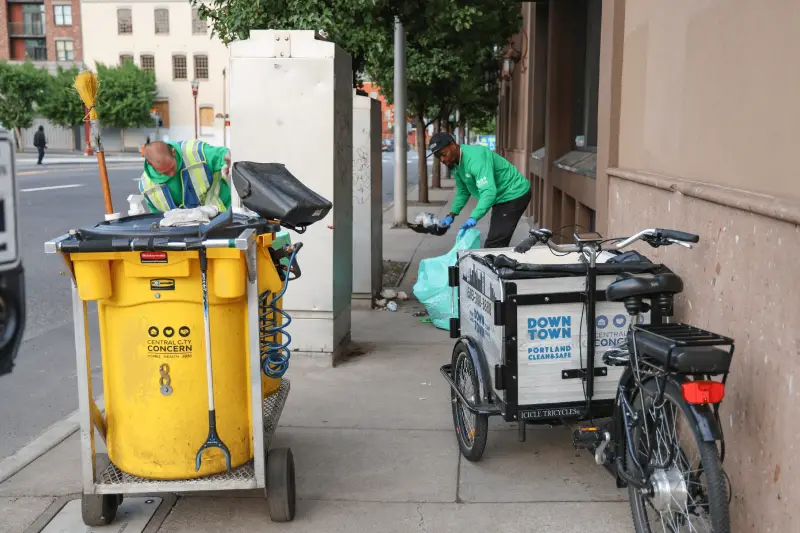
- Employ unhoused people to maintain the commons and scale the programs that already do so.
- Treat public sanitation as necessary infrastructure and staff it. Public sanitation facilities without an attendant and regular maintenance do not survive, and staffing would provide more transitional job opportunities.
- Apply Accountability Criteria (Oregon Harbor of Hope, Hope for the Homeless Foundation) to the cleanliness contracts. The City Auditor's August 2020 report found the city provided little oversight of privately funded public services, such as deterring litter and graffiti.
- Rebuild deflection in Multnomah County, which in its first year received 606 law enforcement referrals constituting less than two drop-offs a day.
- Fund Portland Street Response, an unarmed response to mental health crisis, to 24-hour coverage and evaluate it annually.
- Publish a report quarterly reporting on dollars spent, work performed and outcomes achieved, for all programs addressing homelessness in Multnomah County.
Conclusion
If the divide between those who prioritize compassion and those who prioritize public order continues to widen, taxpayers and governments will tire of funding programs to address homelessness and settle for sweeping people out of view without moving them toward stability. More people will live and die on our streets, and taxpayers will face higher costs for a problem left ineffectively addressed.
Source Notes
Portland Voice Report #2, A Flood of Money / A Dysfunctional System
Portland Voice Report #4, Further Thoughts on the Spending on Homelessness in Multnomah County
City of Grants Pass v. Johnson, June 28, 2024
League of Oregon Cities on House Bill 3115
OPB, Portland camping ban enforcement records, January 21, 2026
Street Roots, 1,566 fewer beds, May 27, 2026
Executive Order 14321, July 24, 2025
HHS funding announcement, June 17, 2026
Treatment Advocacy Center on psychiatric bed capacity
Cochrane review of compulsory community treatment, summarized
Central City Concern Clean Start
Street Roots on Ground Score and GLITTER, May 28, 2025
City of Portland basic sidewalk cleaning, November 3, 2025
Portland Impact Reduction Program dashboard
City Auditor Report #529, Enhanced Services Districts, August 2020
Multnomah County deflection annual report, 2024 to 2025
Multnomah County board resolution on deflection, February 26, 2026
Washington County deflection year one report
City of Portland, five years of Portland Street Response, February 17, 2026
Portland State University, Portland Street Response evaluations
“Somewhere to go,” BMC Public Health, 2022
KGW investigation into Portland public toilets
OPB on Project Sanitation Justice, Eugene, March 12, 2026
Reporting on the Multnomah County Shigella increase, 2022 to 2025
City of Portland on the GLITTER partnership, November 26, 2024
National Low Income Housing Coalition on the vacatur of the funding criteria
About the 2045 Housing Needs Analysis and Housing Production
Other Posts
Report #12 TURNING THE TIDE Reducing the Number of the Homeless
Reality: Inflow Exceeds Outflow Despite immense spending, the Homeless Services Department’s (HSD’s) monthly dashboard reveals a sobering trend. During 2025, the number of people falling into homelessness consistently exceeded those exiting the system. On average, 295 more individuals became homeless each month than those who found a way out. In…
Report #11 CityTeam’s Integrated Program for the Homeless
Previous reports addressed shortcomings of many homeless response programs in the city and county. This report highlights a program that receives no money from the city or county but succeeds in helping the homeless recover and become self-sufficient at remarkably low cost. CityTeam runs four major programs in Portland: 1)…
Report #10 Outreach: the first crucial step
Report #10 Outreach: the first crucial step Principle #2: “Consistent policies, procedures, and data input must be implemented across all outreach efforts. At first contact, outreach workers should introduce individuals to a Service Coordinator Specialist (SCS) to identify their needs, the services and programs available to them, and to chart a…