


Bridge to belonging, purpose, and stability.
Founded in 2016, Oregon Harbor of Hope is a fully privately funded Portland nonprofit built on a conviction: most people can recover, rebuild their lives, and become self-supporting, and the system meant to help them should be held to that standard. We advocate for homeless policy organized around results. We walk alongside women returning from Coffee Creek Correctional Facility until they are safe, stable, and ready to stand on their own. And we report plainly on whether Portland is getting it right.
We advocate, we walk alongside, and we tell the truth about what is working.


Three kinds of work, one purpose.
Oregon Harbor of Hope was founded on a simple observation: Portland spends more on homelessness every year, and the results do not follow. We believe most people can recover, rebuild their lives, and become self-supporting when the help they receive is coordinated, consistent, and measured by outcomes. So we work in three ways, and each one strengthens the others.
Advocacy
We advocate for a homeless system that is organized around results. The Five Principles lay out how a coherent and effective homeless policy should be built, from a unified approach to protecting the commons. The Accountability Criteria give the public a concrete way to judge whether a program actually moves people from the street to stability, including financial security, supported recovery, and housing. We do not write policy. We change the conversation so that better policy follows.
Reentry
We put these principles into practice with women returning from Coffee Creek Correctional Facility to the tri-county area: Multnomah, Clackamas, and Washington counties. A woman released with no housing, no phone, and no one to call faces the highest risk of homelessness and reincarceration in her first weeks out. First Step gives her a peer navigator who has been there, support tailored to her needs instead of a one-size-fits-all program, the basics to get through her first ninety days, and a path to partner organizations that can carry her further. We don't duplicate services; we make sure she reaches the right ones.
Independent reporting
We report, in plain language, on what the county spends on homelessness, what it delivers, and what the results are. Portland Voice draws on the county's own audits, budgets, and data so that residents can judge for themselves whether the system is working, and so that the people the system is meant to serve have a voice in the public record.
The principles say what should change. First Step shows it working. Portland Voice reports whether the system is doing it.
Support our workThree programs.
One advocacy program, one reentry program, one independent newsletter. Each has its own name, its own site, and its own way for you to take part.
 1
1
The Five Principles Campaign
Our advocacy program. The Five Principles are a road map of how to build a coherent and effective homeless policy, and should be understood as an integrated whole. The Accountability Criteria judge whether programs produce measurable and lasting recovery outcomes.
fiveprinciplespdx.org 2
2
First Step Reentry Navigation and Fund
Our reentry program. Peer navigation and customized support for women returning from Coffee Creek Correctional Facility to Multnomah, Clackamas, and Washington counties.
Learn about First Step 3
3
Portland Voice
Our independent reporting program. An investigative and advocacy newsletter on homelessness in Multnomah County.
pdxvoice.org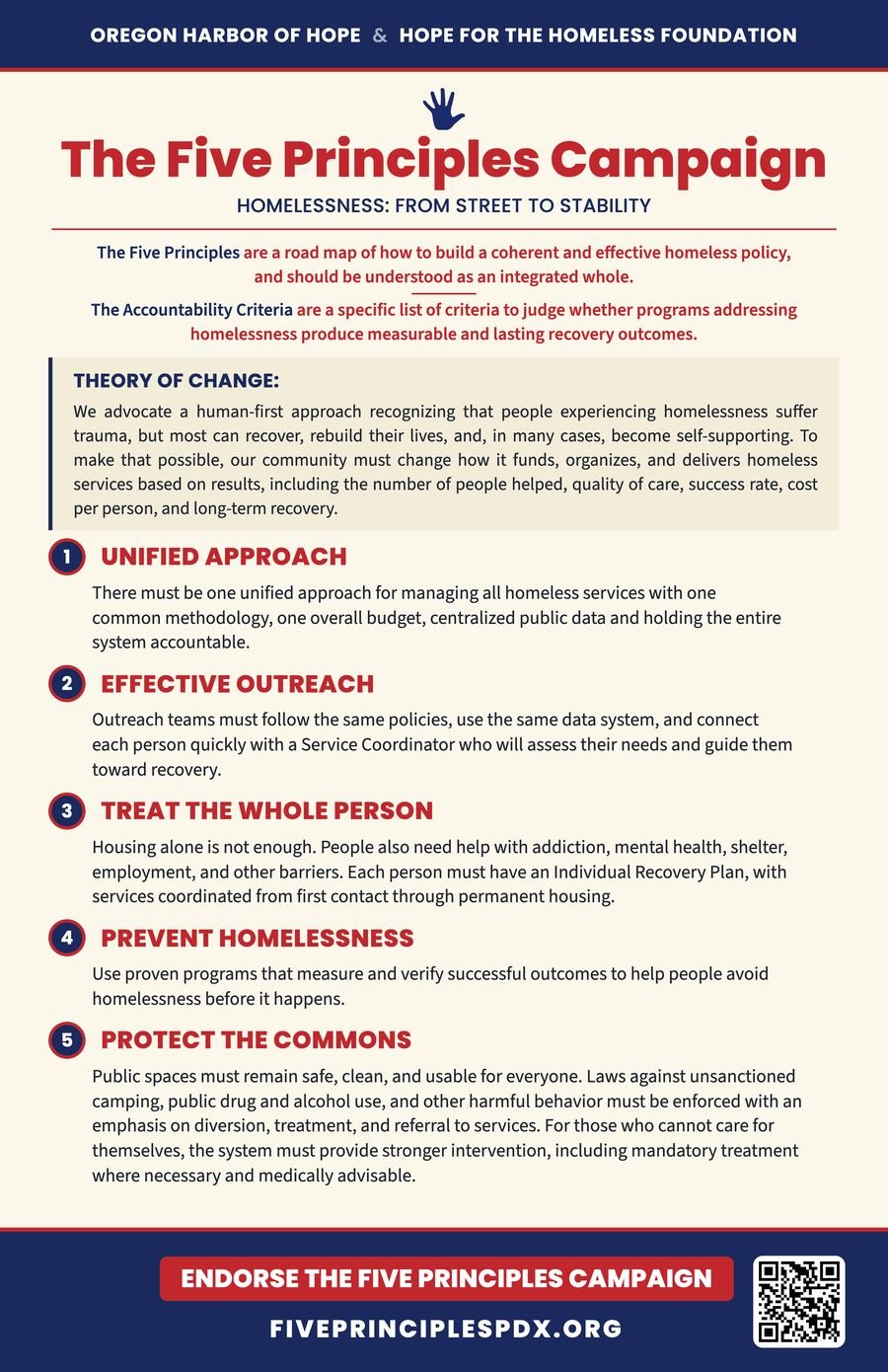
The Five Principles Campaign
Homelessness: From Street to Stability
The Five Principles are a road map of how to build a coherent and effective homeless policy, and should be understood as an integrated whole. The Accountability Criteria are a specific list of criteria to judge whether programs addressing homelessness produce measurable and lasting recovery outcomes.
Theory of Change
We advocate a human-first approach recognizing that people experiencing homelessness suffer trauma, but most can recover, rebuild their lives, and, in many cases, become self-supporting. To make that possible, our community must change how it funds, organizes, and delivers homeless services based on results, including the number of people helped, quality of care, success rate, cost per person, and long-term recovery.
- 01
Unified Approach
There must be one unified approach for managing all homeless services with one common methodology, one overall budget, centralized public data and holding the entire system accountable.
- 02
Effective Outreach
Outreach teams must follow the same policies, use the same data system, and connect each person quickly with a Service Coordinator who will assess their needs and guide them toward recovery.
- 03
Treat the Whole Person
Housing alone is not enough. People also need help with addiction, mental health, shelter, employment, and other barriers. Each person must have an Individual Recovery Plan, with services coordinated from first contact through permanent housing.
- 04
Prevent Homelessness
Use proven programs that measure and verify successful outcomes to help people avoid homelessness before it happens.
- 05
Protect the Commons
Public spaces must remain safe, clean, and usable for everyone. Laws against unsanctioned camping, public drug and alcohol use, and other harmful behavior must be enforced with an emphasis on diversion, treatment, and referral to services. For those who cannot care for themselves, the system must provide stronger intervention, including mandatory treatment where necessary and medically advisable.

The Accountability Criteria
The Accountability Criteria are an integral part of The Five Principles Campaign and are concrete metrics for evaluating programs addressing homelessness to ensure that they assist the homeless in moving from the street to stability, including financial security, supported recovery, and housing.
Together, these metrics reveal whether a program is producing measurable, lasting recovery outcomes and they put into practice the accountability The Five Principles Campaign calls for.
Key Outcome Metrics
- 1
Total number of persons served
- 2
Number of persons still in the program at year-end
- 3
Number of persons who exited the program, including those who left early and those who succeeded in becoming stabilized and housed
- 4
Success Rate: total persons stabilized & housed ÷ total persons exiting the program
- 5
Success Rate 1 Year Later: persons remaining stabilized and housed ÷ previous year's individuals stabilized and housed
- 6
Total annual program costs
- 7
Cost per person successfully stabilized and housed
First Step Reentry Navigation and Fund
A woman leaves Coffee Creek Correctional Facility with nowhere to go. Within weeks, she is on the street or back in prison. First Step is where the principles become practice: one-on-one reentry navigation for women returning to Multnomah County and the tri-county area, Clackamas and Washington counties, with a peer navigator who has been there. No two women need the same things, so no two women get the same plan. Support is customized to what each one actually needs.
- A customized support plan, built with each woman around her own needs, and a peer navigator who walks with her through the first 90 days, with support available for up to 12 months.
- Housing for the first three months, a phone with service, and transportation, so the basics are in place from day one.
- Mentorship and emotional support, so no woman has to figure out her new life alone.
- Emergency funds for the moments that would otherwise send her back to the street.
- Training and employment readiness, so stability leads to work.
- Warm connections to our partner organizations for treatment, employment, and long-term housing.
- A fund-and-navigate model: we do not duplicate services, we make sure each woman reaches the right ones.



Built on what the Adult in Custody told us
Before we designed First Step, we spent two days inside Coffee Creek Correctional Facility. We interviewed about 500 women and collected 200 completed intake surveys from Adults in Custody returning to the community in the next 2 years. They told us where the system breaks and where they really need support. No housing waiting for them. No phone. No ride from the gate. No one to call in the first days after release.
And something harder to say out loud: many of them are afraid. Afraid of going back to the people and the life that put them there. Afraid that the only door open on release day leads to an abusive relationship, or back to the street, or back inside. First Step is built to be the other door.
This is what accountability looks like: preventing homelessness, one person at a time.
First Step is Principle 3, Treat the Whole Person, in practice. Read The Five Principles and The Accountability Criteria at fiveprinciplespdx.org.

Portland Voice
An investigative and advocacy newsletter on homelessness in Multnomah County. Independent analysis of the county's own audits, budgets, and results, written for residents who want to know whether the system is working, and for the people the system is meant to serve.
Get Portland Voice in your inbox. Facts, not talking points, a few times a month.
SubscribePortland Voice reports on the system The Five Principles set out to fix. See the framework at fiveprinciplespdx.org.
We work through partnerships.
Oregon Harbor of Hope does not try to do everything. We connect people to organizations that already do their work well, and we hold ourselves to the same standard we ask of the system.
It's time for accountability.
Endorse The Five Principles Campaign, sponsor a woman coming home, read Portland Voice, or give your time. Each one changes what Portland expects from its homeless system.
© 2026 Oregon Harbor of Hope. Donations are tax deductible to the extent allowed by law.