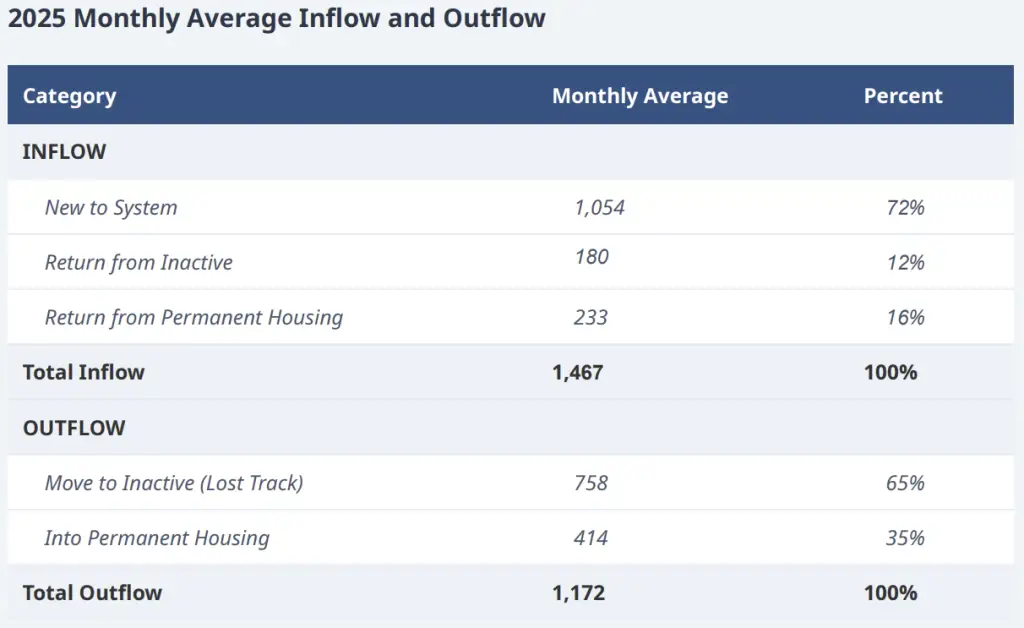
Despite immense spending, the Homeless Services Department’s (HSD’s) monthly dashboard reveals a sobering trend. During 2025, the number of people falling into homelessness consistently exceeded those exiting the system.


On average, 295 more individuals became homeless each month than those who found a way out. In 2025, an average of 1,467 individuals became homeless monthly in Multnomah County, while only 1,172 left homelessness.
Of the outflow, roughly two-thirds "moved to inactive," meaning HSD lost track of them after three
months of no contact. Only one-third moved into permanent housing.
Of the inflow, 12% returned from inactive status and 16% fell out of permanent housing. However, the vast majority—over twothirds—are "new to the system." HSD assumes most are due to evictions, yet there is no data to confirm this, nor do they track the causes of those evictions. Without identifying why people become homeless, it is impossible to determine which programs are effective. In a time of budget cuts, we cannot simply "hope" our spending works. Identifying cost-effective interventions is vital.
The Grant Dilemma: While HSD tracks 8 ethnicities and 8 genders, these categories help with funding but do not identify the root reasons people lose their homes.
Beyond returning from housing or inactive status, several key factors drive new homelessness in our county:
Eviction prevention is theoretically cost-effective. Retaining a home is cheaper and less traumatic than re-housing. Interventions like legal representation or short-term rent assistance for financial "bad luck" (medical bills) are effective. However, for those with behavioral health issues, rent assistance without treatment does not address the root cause of their eviction. Issue: Current applications are complex, favoring those able to navigate systems rather than those most in need.
Studies indicate over 50% of homeless women became homeless due to domestic violence. While vital non-profits provide shelter, the county does not specifically track domestic violence as a primary reason for inflow, potentially masking a need for more prevention services.
Research suggests 31% to 46% of youth exiting foster care experience homelessness by age 26. In Multnomah County, while this affects fewer than 100 youth annually, it remains a small but critical factor with little specific data.
As of August 2025, approximately 330 people were released from state facilities per month. An estimated 16% (53 individuals) are from Multnomah County. This group is highly vulnerable, yet the county lacks data on their housing status upon release, contributing to a cycle of recidivism.
Outreach workers estimate that 30% to 40% of the homeless population comes from outside Multnomah County. The county claims the number is lower, but bases this on flawed Point-in-Time counts.
Rate Comparison: Multnomah County has 10 times the homeless rate of neighboring Clackamas or Washington counties.
We believe several factors attract the homeless population to Multnomah County:
While some argue these policies are "compassionate," they make our jurisdiction more attractive to those who are addicted or already homeless, placing a huge burden on local services and citizens.
To best allocate "prevention" dollars, we must move from assumptions to data-driven strategy.
→ Data Collection: The county must collect data from every new entry to understand why they became homeless and where they came from. This ensures we get the most "bang for our buck."
→ Audit Permanent Housing: We must audit programs to see why "returns" to homelessness are so high and why people "reactivate" after being inactive.
→ Simplify Eviction Prevention: Coordinate agencies to simplify the application system and target those at the highest risk of falling into homelessness.
→ Prison Re-entry Coordination: Work directly with the prison system to ensure seamless re-entry into society with housing and support already in place.
→ Policy Shifts: For those arriving homeless, we must change the policies that attract them. This includes more enforcement of the law and less tolerance for self-destructive and socially-destructive behaviors.
"Above all, we need to determine which sources of homelessness are the largest and focus our efforts there. We must admit that we can’t do everything."
A Plan to Address the Source of Unsheltered Homelessness Presented to the Homeless Solutions Coalition by Ken Thrasher: 12/2/2024 For the last five years unsheltered homelessness has continued to grow in Portland and Multnomah County. Actions to date by the County and City have invested over $1 billion on a…

Report #1: Ending Homelessness Requires Good Data We have not had timely or reliable data on our homeless situation. Even the number of people experiencing homelessness in the county was not known until recently. The January, 2023 Point-in-Time count reported 6,300 homeless people. Using the county’s By-Name-List, they reported 11,135…

Where Does the Money Come From? This blog is organized around the jurisdictions that provide money for shelter, housing and health services in Multnomah County. Often a source of funding moves through several governmental jurisdictions, but the implementation, in the end, is carried out by nonprofit service providers. This…